TMT Test: Full Form, Procedure, Preparation, Results

November 13, 2026
Read time: 11 mins
TMT Test: Full Form, Procedure, Preparation and What the Results Can Tell You
A TMT test is a planned, supervised test. If you have sudden chest pain or pressure, pain spreading to the arm or jaw, cold sweat or sudden breathlessness at any time, do not wait to book a test. Call 112 or go to the nearest hospital straight away.
If a doctor has advised a TMT test, you probably have three questions: what does it involve, is it safe, and what will the result mean? The TMT test is one of the most commonly used heart tests in India, and it is also one of the most misunderstood. People worry about running on a treadmill with wires attached, they wonder whether the result will be a "pass or fail", and they are often unsure whether to eat, take their medicines or wear special clothes. This guide answers these questions in plain language, using information from respected medical sources. It is general information, not medical advice, and your own cardiologist is the right person to decide whether you need the test and what your result means.
TMT Test Full Form and Meaning
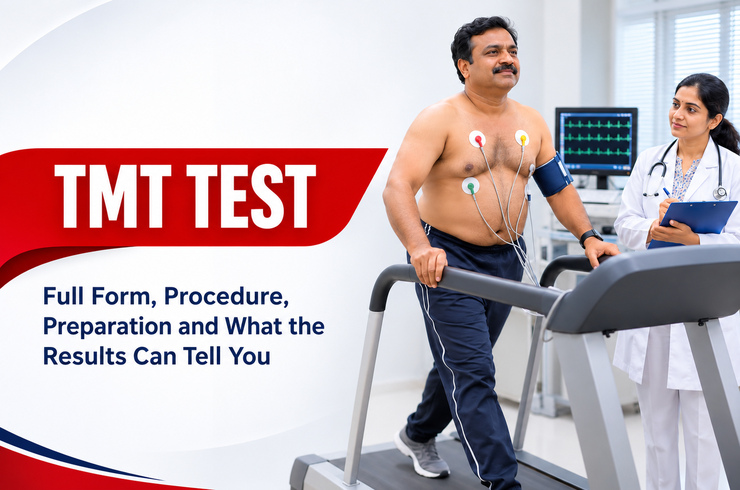
TMT stands for Tread Mill Test. In medical sources it is usually called an exercise stress test or an exercise ECG, and the three names describe the same basic idea: your heart is monitored while you exercise, usually by walking on a treadmill that gradually becomes faster and steeper. According to Mayo Clinic, an exercise stress test shows how the heart works during physical activity, and it can reveal changes in blood flow within the heart.
That is the reason for the test. A resting ECG can look normal in some people with narrowed heart arteries, partly because the heart's demand for blood is lower at rest. When the heart works harder, a narrowed artery may not supply enough blood, and the electrical tracing may change or symptoms may appear. A TMT test is designed to bring out that difference under controlled, monitored conditions.
Why Do Doctors Advise a TMT Test?
Mayo Clinic lists several reasons. A stress test may be used to help diagnose coronary artery disease or an arrhythmia, to check whether a heart treatment is working, to help guide treatment decisions, and to assess heart function before surgery such as a valve replacement or heart transplant. You can read the full explanation on the Mayo Clinic stress test page.
The NHS also lists exercise stress tests among the further tests that may be used when coronary heart disease is suspected, alongside the ECG, echocardiogram, angiography and CT scans. In practice, a doctor may suggest a TMT test when someone has chest discomfort or breathlessness on effort, when risk factors such as diabetes, high blood pressure or a strong family history are present, or when a known heart patient needs a progress check. The NHS diagnosis page gives the list.
How to Prepare for a TMT Test
Preparation instructions vary between hospitals, so always follow the written or spoken instructions of the centre doing your test. Mayo Clinic gives the following general guidance:
• You may be told not to eat, drink or smoke for a period before the test.
• Avoid caffeine the day before and on the day of the test.
• Ask your doctor whether you should take your regular medicines before the test. Do not stop any medicine on your own.
• If you use an inhaler for asthma or breathing problems, bring it and tell the team.
• Wear comfortable clothes and walking shoes.
It is also sensible to carry your previous ECG tracings, reports and a list of all your medicines, so the doctor has the full picture. If you have chest pain on the morning of the test, or you feel unwell in any way, call the centre before you travel.
TMT Test Procedure: What Happens Step by Step
Mayo Clinic describes the usual sequence. Knowing it in advance removes much of the anxiety.
• Questions and a check: you are asked about your medical history and exercise habits, and your heart and lungs are checked.
• Electrodes: sticky patches are placed on the chest, and sometimes on the arms and legs, to record your heartbeat as an ECG. Body hair may be shaved so the patches stick.
• Blood pressure: a cuff on your arm measures blood pressure during the test. Some centres also ask you to breathe into a tube to measure breathing during exercise.
• Exercise: you walk on a treadmill, or in some centres pedal a stationary bike, starting easy and becoming harder. You may use the railing for balance, but holding on tightly can affect the results.
• Recovery: afterwards you stand briefly and then lie down while the staff continue to monitor your heart rate and breathing. You can usually resume normal activities.
The total visit takes about an hour including preparation, according to Mayo Clinic, and the exercise portion itself is about 15 minutes. If you cannot exercise, for example because of arthritis or another condition, Mayo Clinic notes that you may be given an intravenous medicine that increases blood flow to the heart in a way similar to exercise. Your doctor will decide which approach suits you.
Can I stop during a TMT test?
Yes. Mayo Clinic says you can stop at any time if you are too uncomfortable. The staff may also stop the test themselves if they are concerned about your heart's response. Symptoms that may end the test early include moderate to severe chest pain, severe shortness of breath, unusually high or low blood pressure, an irregular heartbeat, dizziness or fatigue. Tell the technician immediately if you feel any chest pain, breathlessness, dizziness or unusual discomfort; do not try to push through for the sake of the result.
Is a TMT Test Safe?
Mayo Clinic describes an exercise stress test as generally safe, with complications being rare. Possible complications include a drop in blood pressure that can cause dizziness or fainting, abnormal heart rhythms that usually settle once exercise stops, and, very rarely, a heart attack. This is why the test is carried out where trained staff are present and equipment to monitor and respond is at hand, and why you should do it only under medical supervision. Your doctor weighs these small risks against the benefit of the information the test provides.
Understanding Your TMT Test Result
The Mayo Clinic page does not define specific normal or abnormal values, and that is deliberate: interpretation depends on the whole picture, including your symptoms, your blood pressure and heart rate response, the ECG changes during exercise, and your risk factors. Reports in India often use short labels such as negative or positive. These labels can sound alarming or falsely reassuring, so ask the doctor to explain in plain words what the result means for you.
Mayo Clinic explains how results are used. If the heart appears to work well during the test, further testing may not be needed. If the test suggests coronary artery disease, a coronary angiogram may be recommended to look for artery blockages. If results are acceptable but symptoms worsen, further testing such as a nuclear stress test or a stress test with echocardiography may be advised. In other words, a TMT test is usually one step in a pathway, not the last word.
Limits of the TMT Test
Like every test, the TMT test has limits, and understanding them protects you from both false alarm and false comfort.
• It looks at how the heart behaves under exercise stress, not directly at the arteries. Seeing the arteries needs imaging such as angiography or CT, which the NHS lists as separate tests.
• A normal result with worsening symptoms may still need more testing, as Mayo Clinic notes.
• If you cannot exercise adequately, the information from a treadmill test may be limited, and your doctor may choose a different kind of stress test.
• Results should always be read alongside symptoms, risk factors and other tests, not in isolation.
TMT Test vs ECG vs Other Heart Tests
A resting ECG, as MedlinePlus explains, records the heart's electrical signals over a very short time while you lie still. A TMT test records the same kind of tracing, but during exercise. An echocardiogram uses sound waves to look at the structure and pumping of the heart. Angiography and CT scans look at the arteries. Doctors choose from these depending on your symptoms and history, which is why the sequence of tests can differ from one person to another. If you are unsure why a particular test has been ordered, ask your doctor to explain what question it is meant to answer.
Chest Pain and the TMT Test: Know the Difference Between Testing and Emergency
A TMT test is for planned assessment. It is not a way to check whether current chest pain is serious. The NHLBI explains that angina pain can feel like pressure, squeezing, tightness or burning, and may spread to the shoulders, arms, neck, jaw or back; angina pain usually follows physical activity and eases within minutes of rest or medicine, while heart attack pain does not go away with rest or medicine. If you cannot tell which it is, the NHLBI advice is to call emergency services, and not to drive yourself. In India, call 112. See the NHLBI pages on angina and heart attack symptoms.
A Checklist for the Day of Your TMT Test
• Confirm the time, the fasting instructions and whether to take your medicines.
• Avoid caffeine on the day, and the day before.
• Wear comfortable clothes and walking shoes.
• Carry earlier reports, ECG tracings and your medicine list.
• Bring your inhaler if you use one.
• Tell the staff about any chest discomfort, dizziness or breathlessness before and during the test.
• Ask when and how you will get the report, and book the follow-up with your doctor.
Finding a Centre
If you would like a cardiologist to review your TMT test report or to discuss whether the test is right for you, you can see SAAOL's centres on the centre locator. Please carry all your previous reports, and a list of your medicines.
Frequently Asked Questions About the TMT Test
What is the full form of TMT test?
TMT stands for Tread Mill Test. It is also called an exercise stress test or exercise ECG.
How long does a TMT test take?
According to Mayo Clinic, the whole visit takes about an hour including preparation, and the exercise portion is about 15 minutes.
Is the TMT test painful?
The test is not painful in itself, but you will be exercising, so you may feel tired or breathless. Tell the staff immediately if you feel chest pain, dizziness or severe breathlessness.
Do I need to fast before a TMT test?
Mayo Clinic says you may be told not to eat, drink or smoke for a period before the test. The exact instruction depends on the centre, so follow the one you are given.
Should I take my medicines before a TMT test?
Ask your doctor or the centre. Mayo Clinic advises asking the clinician whether to take medicines before the test. Do not stop any medicine on your own.
What if I cannot walk on a treadmill?
Mayo Clinic notes that people who cannot exercise may receive an intravenous medicine that increases blood flow to the heart, similar to exercise. Your doctor will advise the best approach.
Can a TMT test detect a heart blockage?
It can suggest that the heart is not getting enough blood during exertion. If the result points to coronary artery disease, Mayo Clinic notes that a coronary angiogram may be recommended to look for blockages. The TMT test alone does not show the arteries.
If my TMT test is normal, am I completely safe?
Not necessarily. Mayo Clinic notes that if symptoms worsen despite acceptable results, further testing may be advised. Keep your doctor informed about any new or worsening symptoms.
How often should a TMT test be repeated?
There is no fixed schedule for everyone. Your doctor decides based on your symptoms, your risk factors and your treatment, so ask when your next review should be.
The Takeaway
The TMT test is a monitored, generally safe way of seeing how your heart behaves when it works harder. Prepare as instructed, tell the team about any symptoms during the test, and treat the result as one piece of information that your doctor will combine with your history and other tests. Keep taking prescribed medicines unless your doctor advises otherwise, and treat sudden chest symptoms as an emergency by calling 112.
A Note Before You Go
This article is general health information. It is not medical advice and does not replace an examination or the advice of your own doctor. Please do not start, stop or change any medicine on the strength of this article; talk to your cardiologist or physician first. For personal guidance you can book an appointment or use the contact page.